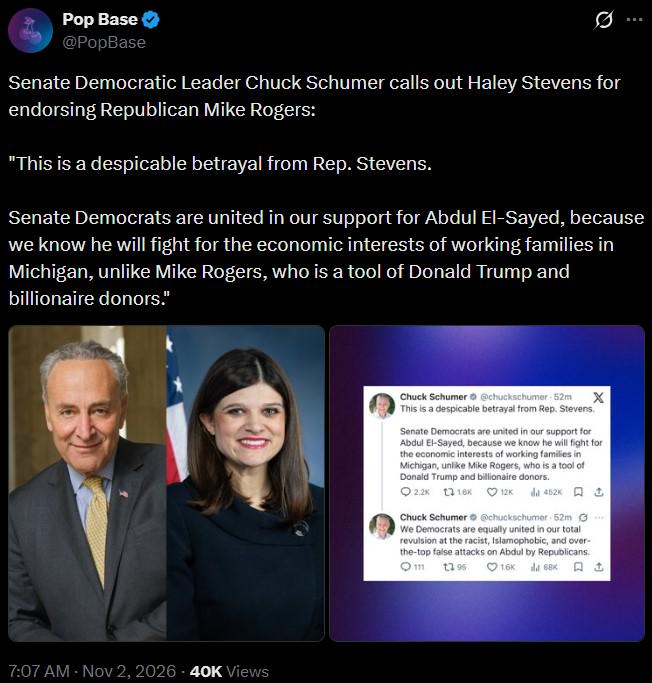
A high-stakes U.S. Senate race in Michigan has erupted into party turmoil following an unexpected endorsement that sent shockwaves through national and state political circles. Representative Haley Stevens, who previously competed in the Democratic primary, publicly crossed party lines to endorse Republican nominee Mike Rogers just days before the election. The decision drew an immediate, fierce rebuke from national Democratic leaders, exposing deep ideological and strategic fractures within the party establishment.
Senate Democratic Leader Chuck Schumer issued a remarkably harsh public condemnation of the endorsement, calling it a "despicable betrayal". Schumer reaffirmed party leadership's full backing of the Democratic nominee, Abdul El-Sayed, emphasizing that the party remains committed to supporting candidates focused on the economic interests of working families in Michigan. The sharp rhetoric underscored the intense pressure surrounding a tight battleground contest where control of the Senate majority hangs in the balance.
Internal Fractures and Escalating Tensions
The unexpected turn of events quickly turned a high-profile Senate contest into a focal point of internal party debate. Stevens had previously been seen as aligned with the party's mainstream wing during the primary campaign, making her cross-party backing of a Republican candidate all the more shocking to party strategists and supporters.
Observers and voters expressed surprise at the escalation, noting the unusual severity of the public fallout between establishment figures and former allies. As one reaction put it:
"He used the phrase 'despicable betrayal' like she personally took his favorite spot in the Senate cafeteria ???"
Others noted the irony of party leadership sternly admonishing a candidate who had previously enjoyed mainstream backing during primary contests, highlighting the delicate balance between party loyalty and coalition management:
"My guy, you were the one who chose that ghoul for the primary in Michigan... Your statement is welcomed but you're the one who prompted all these DINO inside the party."
The High Stakes of Midterm Coalition Building
Cross-party endorsements in major Senate contests are exceedingly rare, particularly in modern, highly polarized midterm cycles. Party leaders generally expect defeated primary opponents to unify behind the official nominee to maximize voter turnout and maintain seat counts. Stevens' decision to break ranks so close to Election Day sparked debate over party discipline and the influence of national leadership.
Some political observers viewed the swift public condemnation by top leadership as a necessary attempt to maintain party cohesion and prevent further defections:
"This is what happens when you have zero discipline in a party."
Others argued that the high-profile public dispute might inadvertently rally grassroots support behind the Democratic nominee by forcing party officials to offer a more emphatic endorsement than they otherwise might have:
"Stevens forcing the Democratic establishment to go hard for El-Sayed in a way that they weren't going to do yesterday"
Repercussions and Path Forward
With early voting already well underway across Michigan, both parties are assessing the fallout of the high-profile defection. While local party leaders moved quickly to distance themselves from Stevens and reiterate their support for El-Sayed, the incident illustrates the ongoing ideological debate within the Democratic coalition over candidate selection, endorsement strategy, and long-term party unity.
Whether the last-minute controversy alters voter turnout or simply cements existing partisan lines remains to be seen on Election Day. However, the rare public rift between a sitting Democratic representative and the party's Senate leader highlights the volatile dynamics shaping pivotal battleground races across the country.